
Healthcare in Poland for British Expats: Myths, Reality and What to Plan
British movers often bring NHS assumptions into a very different Polish system. Learn how NFZ, private care, GHIC limits and English access affect your relocation decision before you commit.
By Move2Poland··Updated 17 September 2026
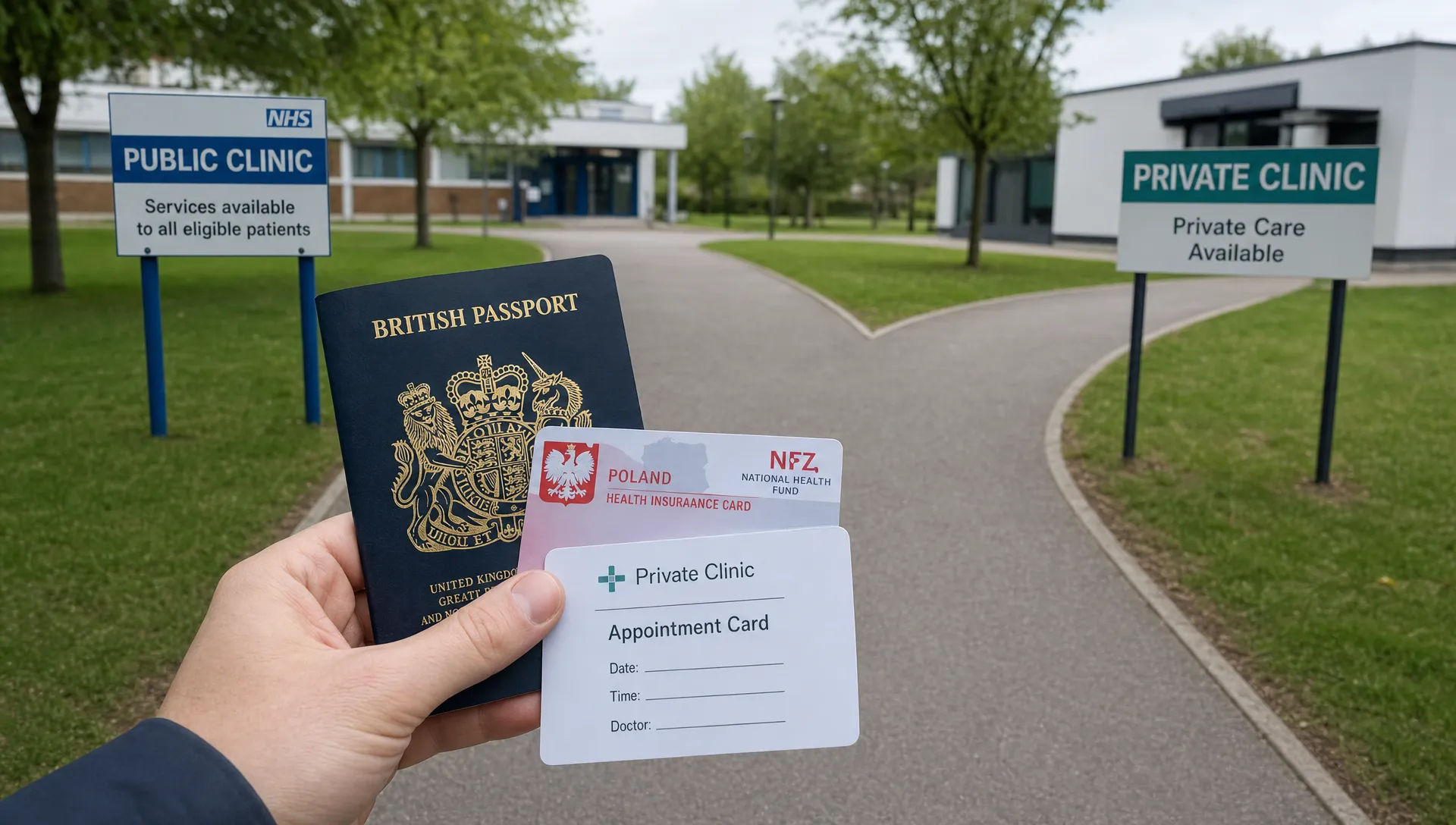
For many British movers, healthcare is one of the biggest emotional barriers to relocating. You may be comfortable with the idea of a new city, a different tax system or learning some Polish, but the thought of needing a doctor in an unfamiliar system can quickly turn a practical decision into a stressful one.
That is why healthcare in Poland for UK expats needs a more careful explanation than “it’s public” or “just get private cover”. Poland does have a publicly funded healthcare system, organised through the National Health Fund (NFZ). It also has a large private healthcare market, especially in bigger cities. But your access as a British citizen depends on your legal, work, pension, student, family and insurance situation. It does not come automatically from being British, owning a flat or simply living in Poland.
This article is not medical advice and it is not a full administrative setup guide. Instead, it explains the assumptions British movers often bring from the NHS context, what the Polish system actually looks like at a high level and what you should think through before you commit.
The biggest NHS assumption: “residence means access”
The NHS has trained most of us to think of healthcare as a national public service attached to ordinary life in the UK. If you live in the UK lawfully and are ordinarily resident, you generally expect to register with a GP and use the NHS without thinking about insurance status each time.
Poland works differently. The public system is funded through the Narodowy Fundusz Zdrowia, usually shortened to NFZ. Access is tied to being insured under Poland’s health insurance system or having another valid entitlement route, such as certain pension, work, family or cross-border arrangements. The UK government’s healthcare guidance for Poland is clear that UK nationals should understand their rights before assuming they can use healthcare in Poland on the same basis as they did in the UK.
For British citizens, entitlement is therefore circumstantial. A UK employee sent to Poland, a remote worker employed by a Polish company, a self-employed person, a spouse of an insured person, a student, a retiree receiving a UK State Pension and a person moving without work may all face different routes and obligations. The key point is not memorising every route before you move. It is understanding that nationality alone is not the answer.
If your residence status is still unclear, healthcare should be considered alongside your visa and stay rights, not after them. The same applies if you are comparing employment, self-employment or remote work arrangements. For the immigration side, Move2Poland’s guide to post-Brexit visas for UK citizens moving to Poland is a useful starting point before you make assumptions about healthcare entitlement.
How public and private healthcare coexist in Poland
Poland is not a simple “public or private” system. It is more accurate to think of three layers:
| Layer | What it usually covers | What British movers often misunderstand | |---|---|---| | Public NFZ healthcare | Primary care, specialist care, hospital treatment, emergency services and some reimbursed medicines for eligible people | Access depends on insured status or another entitlement route, not just living in Poland | | Private medical subscriptions or insurance | Faster access to many outpatient appointments, tests and private clinics, depending on the package | Private care does not necessarily replace public entitlement for serious, emergency or long-term needs | | Out-of-pocket care | Paying directly for private consultations, dental care, tests or treatment | Paying privately can be convenient, but costs can mount if you rely on it for everything |
The public system is the backbone. It is where most serious hospital care, emergency response and many long-term treatments sit. The private system is widely used by Polish residents and expats because it can make day-to-day access quicker and easier, particularly for GP-style consultations, paediatrics, gynaecology, dermatology, diagnostics and some specialist appointments.
Many employers offer private medical packages as a benefit. Many individuals also pay directly for private visits. This is common, but it should not be confused with having a complete healthcare safety net.
Myth 1: “Healthcare is automatically free once I live in Poland”
This is one of the most common and risky assumptions.
Public healthcare in Poland may feel “free at the point of use” once you are properly covered, but it is not automatically free merely because you have moved. The NFZ administers publicly funded healthcare for insured people and other eligible groups. Whether you are covered depends on how you fit into the system.
For working-age movers, the question is often linked to employment, self-employment or contributions. For retirees, the question may involve S1 entitlement or other pension-related arrangements. For family members, the answer can depend on whether they are covered through an insured person. For people arriving without work, entitlement needs to be checked before assuming access.
This matters because moving first and sorting healthcare later can leave gaps. That risk is especially serious if you have children, regular prescriptions, a chronic condition or a planned treatment need.
A better question than “is healthcare free in Poland?” is: what gives me, personally, the right to use NFZ-funded healthcare, and when does that right begin?
Myth 2: “My EHIC or GHIC covers me after relocating”
The UK Global Health Insurance Card (GHIC) and older valid EHIC cards are commonly misunderstood. They are designed for necessary state healthcare during temporary stays in many European countries. They are not a substitute for arranging healthcare if you become resident abroad.
The UK government’s GHIC guidance makes this distinction important: the card is for temporary visits, not for moving your life to another country. If you are relocating to Poland, you need to understand your resident healthcare position rather than relying on a travel healthcare card.
This misunderstanding can catch out people who plan to “test Poland for a few months” and then drift into a longer stay. A trial period is sensible, but the healthcare implications change as your situation changes. A temporary visitor, a person in the middle of a move and a resident with work or pension arrangements are not necessarily treated the same.
Myth 3: “Private healthcare replaces everything”
Private healthcare in Poland can be excellent for convenience, especially in Warsaw, Kraków, Wrocław, Gdańsk and other larger cities. Many British expats find it easier to book a private appointment than to navigate the public system at first. English-speaking doctors are also easier to find privately in major urban areas.
But private healthcare has limits.
Private packages vary widely. Some focus on outpatient consultations and basic diagnostics. Some exclude pre-existing conditions, hospital treatment, maternity care or advanced procedures. Some work mainly through a network of specific clinics. Paying per visit can be straightforward for occasional needs, but it is not the same thing as a long-term plan for serious illness, emergency treatment or ongoing specialist care.
For families, the private-public balance can become more complex. A private paediatrician may be convenient for minor illnesses, but vaccinations, hospital referrals, emergency treatment and specialist pathways may still involve the public system. For retirees, private appointments can reduce friction, but long-term care, medications and chronic condition management need more careful planning.
Private healthcare is best viewed as a complement to a properly understood entitlement position, not as a magic replacement for it.
Myth 4: “Polish healthcare is simply better, or simply worse, than the NHS”
Comparing Poland healthcare vs NHS is tempting, but it can become misleading quickly. Both systems have strengths and frustrations. Both can involve waiting. Both can deliver very good treatment in some settings and bureaucratic irritation in others.
The bigger difference for a British mover is not an abstract ranking. It is how the system feels when you are trying to access care in a new language, in a new city and under a different insurance model.
| Issue | NHS context | Poland context | |---|---|---| | Access basis | Usually linked to ordinary residence in the UK | Usually linked to NFZ insurance or another valid entitlement route | | GP role | GP is the familiar front door for most non-emergency care | Primary care exists through POZ doctors, but the pathway and patient habits may feel different | | Specialist access | Referral routes and waiting times vary by area and specialty | NFZ specialist care often uses referrals, while private consultations may be quicker depending on location and specialty | | Private care | Optional, often used to bypass waits or access extras | More routinely used by many urban professionals and expats for outpatient care | | Language | English by default | Polish by default, with English more available in private clinics and larger cities | | Digital systems | NHS app and local NHS systems | Poland uses e-health tools such as e-prescriptions and patient portals, but access and usability depend on your status and setup |
The practical question is not “which country has better healthcare?” It is: given my age, health, family situation, language ability, work status and city choice, how would I realistically access care in Poland?

Myth 5: “English-speaking care is equally accessible everywhere”
English-speaking healthcare is much easier to find in Poland’s largest cities than in smaller towns. Private clinics in Warsaw, Kraków, Wrocław, Gdańsk and Poznań often advertise English-speaking doctors or reception support. International employers may also offer private medical packages that make English-language access easier.
Outside larger urban centres, English availability can be patchier. You may still find excellent doctors, but the administrative process, reception desk, forms, referrals and hospital communication may be mainly in Polish. In emergency settings, you cannot assume fluent English will be available at every stage.
This matters for city selection. A single healthy remote worker may be comfortable living in a smaller city and paying privately when needed. A family with young children, a pregnant partner or a child with specialist needs may prioritise a city with stronger private clinic access, paediatric care and international school options. A retiree may care less about nightlife and more about proximity to hospitals, transport, pharmacies and reliable everyday support.
If you are already comparing cities, healthcare access should sit alongside rent, schools, transport and language comfort. For example, when weighing Wrocław against Kraków, it is worth considering not only cost and lifestyle, but also how easy it would be to find English-speaking clinics and specialist care. Move2Poland’s comparison of Wrocław vs Kraków for British expats can help you frame that wider city decision.
Primary care, specialists and waiting: what to expect at a high level
In the Polish public system, primary care is delivered through POZ, which roughly plays the first-contact role that many British people associate with general practice. You may need referrals for many specialist services under NFZ, though there are exceptions. Waiting times can vary by region, specialty and provider.
Private care can shorten the wait for many outpatient consultations. This is one reason expats often use private clinics even when they are also covered by NFZ. However, private speed is not universal. Some specialists are in high demand everywhere, and private access depends on location, clinic networks and the nature of the problem.
For British expat healthcare in Poland, the real planning issue is continuity. If you need regular monitoring, repeat prescriptions or specialist input, do not assume that a system you have never used will absorb you smoothly without preparation. You need to understand where your care would sit: public, private or a mixture.
Prescriptions are another area where assumptions can fail. Medicines available in the UK may have different brand names, reimbursement rules or availability in Poland. Poland has digital prescription systems and a large pharmacy network, but you should not treat this as a reason to arrive without understanding how your regular medication would be managed. If you have a medical condition, speak to qualified healthcare professionals before making decisions about treatment or medication changes.
Emergency care and urgent situations
In urgent or life-threatening situations, Poland has emergency services and hospital emergency departments. The European emergency number 112 works in Poland. Hospital emergency departments are commonly referred to as SOR, from Szpitalny Oddział Ratunkowy.
For a British mover, the issue is not whether emergency care exists. It does. The issue is what happens afterwards: proof of entitlement, communication, follow-up care, prescriptions, referrals, records and payment responsibility if you are not properly covered. These are the points that can become stressful if you assumed the system would mirror the NHS.
If you are moving with children or elderly relatives, make sure you understand where your nearest urgent care and hospital options are before choosing an area. This is part of location planning, not just healthcare planning.
Why families, retirees and younger professionals should evaluate healthcare differently
A 29-year-old remote worker, a family with two children and a retired couple are not solving the same healthcare problem.
For younger professionals, the main concerns are often eligibility through work, access to English-speaking private clinics, mental health support, dental care and what happens between jobs or contracts. If your move is connected to building a company, advising investors or taking a senior commercial role across markets, healthcare is only one part of risk planning. For the business side, some people use external commercial support such as a revenue acceleration consultancy for PE and portfolio companies, but your personal relocation planning still needs to cover healthcare, residency and social security clearly.
For families, the decision is more layered. You may need paediatric care, vaccinations, dentistry, orthodontics, speech therapy, allergy support, maternity services or specialist assessments. School location and clinic access can interact more than you expect. A cheaper district is less attractive if every appointment becomes a cross-city logistical exercise.
For retirees, the healthcare question is often central to the move. It is not enough to ask whether Poland is cheaper than the UK or whether private consultations are affordable. You need to think about long-term prescriptions, mobility, access to specialists, emergency support, whether you may be eligible for an S1 arrangement and how comfortable you would feel using Polish-language services when stressed or unwell. If retirement is your main reason for considering Poland, healthcare should be considered alongside housing, pensions, tax, family support and lifestyle.
The cost question: public cover, private access and realistic budgeting
Healthcare costs in Poland are not only about insurance premiums or consultation fees. Your budget may include private visits, dental treatment, prescriptions, diagnostic tests, travel to clinics, translation help and occasional out-of-pocket payments. If you have children or chronic conditions, those costs can be more regular than you expect.
Private outpatient appointments in Poland are often cheaper than equivalent private appointments in the UK, but that does not mean a private-only approach is financially safe. A few appointments are one thing. Ongoing treatment, multiple family members or unexpected hospital needs are another.
This is why healthcare should be part of your wider cost-of-living picture. If you are estimating whether Poland is affordable, include realistic healthcare assumptions rather than treating them as an afterthought. Move2Poland’s breakdown of the cost of living in Poland for expats can help you place healthcare alongside housing, groceries, transport and family expenses.
What to establish before you commit
You do not need to become an expert in Polish healthcare law before deciding whether to move. But you do need enough clarity to avoid false confidence.
Before committing to a move, establish these decision-level points:
- Whether your likely work, pension, study, family or residence situation gives you NFZ entitlement, or whether you need another arrangement.
- Whether a private medical package would be a convenience layer, a temporary bridge or a core part of your access plan.
- Whether your preferred city has realistic English-speaking options for your household’s needs.
- Whether any regular medications, therapies or specialist care can be continued safely in Poland.
- Whether your family structure makes healthcare access a city-selection issue rather than a minor admin point.
- Whether you are relying on a GHIC or EHIC in a way that only applies to temporary stays.
Notice what this list does not do. It does not give you a full registration procedure, an insurance-buying workflow or a document checklist. Those details depend on your circumstances and they can change. At the decision stage, your job is to understand the moving parts well enough to ask the right questions before you uproot your life.
Frequently Asked Questions
Is healthcare in Poland free for UK expats? Not automatically. Public NFZ-funded healthcare depends on your insured status or another valid entitlement route. A British citizen living in Poland may be covered through work, self-employment, pension arrangements, family status or other routes, but you should not assume access just because you reside there.
Can I use my UK GHIC or EHIC after moving to Poland? A GHIC or valid EHIC is for necessary state healthcare during temporary stays. It is not a long-term healthcare solution once you relocate. If you become resident in Poland, you need to understand your resident entitlement position.
Do British expats in Poland need private healthcare? Many use private healthcare for convenience, faster outpatient appointments or English-speaking access, especially in large cities. But private care should usually be seen as a complement to a properly understood public entitlement position, not a full replacement for it.
Is Polish healthcare better than the NHS? It depends what you are comparing. Poland may offer faster private outpatient access in some situations, while the NHS is familiar and English-language by default for UK residents. The more useful question is how easily you and your household can access appropriate care in your chosen Polish city.
Is English-speaking healthcare easy to find in Poland? It is easier in major cities and private clinics. In smaller towns, English-speaking doctors and administrative support can be less predictable. Families and retirees should treat language access as a serious location-planning factor.
Make healthcare part of the relocation decision, not an afterthought
Healthcare is one of those topics that looks simple until your own circumstances enter the picture. Your age, work status, pension position, children, medication, language comfort and city choice all affect the answer.
The safest approach is not panic and not blind optimism. It is to place healthcare inside the wider relocation decision, alongside visas, tax, housing, schools, costs and lifestyle. That is exactly the kind of joined-up thinking Move2Poland’s Decision Guide is designed to support, so you can decide whether Poland is genuinely right for you before you commit.