
How to Get Polish Citizenship: Routes, Rules and Timelines
Polish citizenship is usually the final step after residence, language and paperwork, not the first move. This guide explains the main routes, realistic timelines and traps for UK citizens planning a future in Poland.
By Move2Poland··Updated 17 September 2026

Polish citizenship is not the first document most UK citizens need when moving to Poland. It is usually the end point of a longer path: lawful residence, stable life in Poland, paperwork, language and, in some cases, proof of Polish ancestry.
That distinction matters. A British citizen can visit Poland visa-free for short stays, but living, working and later qualifying for citizenship are separate legal stages. If you searched for Poland citizenship, you are probably trying to understand which route applies to you and how long it might realistically take.
This guide explains the main routes to Polish citizenship as they stand in 2026, with a practical focus on UK movers. It is not legal advice, and citizenship rules can be affected by your personal history, family documents and residence record. Use this as a planning guide, then verify details with the relevant voivodeship office, Polish consulate or an immigration lawyer if your case is complex.
Quick answer: the main routes to Polish citizenship
Polish citizenship can be acquired or confirmed in several ways. The right path depends on whether you already have Polish citizenship through a parent or ancestor, whether you live in Poland long term or whether you qualify under a special route such as restoration or repatriation.
The Polish government’s citizenship information page is the official starting point for forms and current procedural guidance, but the table below gives you the practical overview first.
| Route | Who it usually fits | Decision maker | Rough timeline | |-------|----------------------|----------------|----------------| | Citizenship by descent or birth | People with a Polish parent, or in some cases an unbroken citizenship line through ancestors | Voivode, with consular involvement if abroad | Often months to 2+ years, depending on documents | | Recognition as a Polish citizen | Long-term residents in Poland who meet residence, language and stability requirements | Voivode | Usually after 1, 2, 3 or 10 years under the relevant rule | | Grant by the President | People asking for discretionary citizenship, often with strong Polish ties or exceptional circumstances | President of Poland | No fixed statutory timeline | | Restoration of citizenship | Former Polish citizens who lost citizenship before 1 January 1999 | Minister of Interior and Administration | Case-specific, often many months | | Repatriation or Pole’s Card related route | People of Polish origin who meet specific legal conditions | Various authorities depending on route | Can be faster, but only for narrow categories |
The most important point for new UK movers is simple: if you have no Polish ancestry and no Polish spouse, citizenship is usually an 8 year plus journey from the time you establish lawful residence in Poland. It can be shorter for people with Polish origin, a Polish spouse or an existing citizenship claim by descent.
Citizenship is different from residence
Before thinking about citizenship, most UK citizens need to solve the residence question. Since Brexit, UK citizens who move to Poland are generally treated as non-EU nationals unless they are covered by specific Withdrawal Agreement rights.
Short visits are not the same as living in Poland. Visa-free travel normally allows stays of up to 90 days in any 180-day period in the Schengen Area. If you want to work, study, join family or settle, you need the right residence basis and, in many cases, a residence card known as a Karta Pobytu.
If you are still at that stage, read Move2Poland’s guide to post-Brexit visas for UK citizens moving to Poland before treating citizenship as the immediate goal. Citizenship planning only works if your underlying residence history is clean.
Route 1: Polish citizenship by descent or birth
Poland follows a bloodline principle more than a place-of-birth principle. In simple terms, a child usually acquires Polish citizenship if at least one parent is a Polish citizen at the time of the child’s birth.
This means two things. First, being born in Poland does not automatically make a child Polish in the broad birthright sense used in countries such as the United States. Second, some people born outside Poland may already be Polish citizens without realizing it.
If you have a Polish parent, grandparent or great-grandparent, your question may not be how to get Polish citizenship, but how to confirm that you already have it. The process is usually called confirmation of possession of Polish citizenship.
A descent case normally turns on documents and continuity. You may need to prove:
- The Polish citizenship of your ancestor
- The chain of births, marriages and name changes linking that person to you
- That citizenship was not lost under the law in force at the relevant time
- That foreign naturalization, military service, public office or other events did not break the chain
- That all foreign civil status records are properly legalized, apostilled and translated where required
These cases can be document-heavy. A person with a Polish grandparent who emigrated to the UK may have a strong claim, but small details can matter, especially if the ancestor naturalized abroad, served in a foreign army or left Poland during a period when citizenship law was different.
If your descent claim succeeds, you are not being granted citizenship as a new privilege. The Polish authorities are confirming a legal status that already exists. After that, practical steps may include registering foreign birth or marriage records in Poland, obtaining a PESEL number and applying for a Polish passport.
Route 2: recognition as a Polish citizen after living in Poland
For many foreigners who actually relocate to Poland, recognition as a Polish citizen is the main naturalization-style route. This is handled by the voivode for your place of residence, not by the President.
Recognition is more rules-based than a presidential grant. If you meet the legal conditions and provide the right evidence, the authority assesses your application through an administrative process. If you are refused, appeal rights may be available.
The exact category matters. Common adult routes include:
| Recognition category | Core residence condition | Other common requirements | |----------------------|--------------------------|---------------------------| | Standard long-term route | 3 years of continuous residence in Poland on permanent residence, EU long-term resident status or permanent right of residence | Stable regular income, legal title to accommodation, Polish language proof | | Polish spouse or stateless person route | 2 years of continuous residence on permanent residence, EU long-term resident status or permanent right of residence | Marriage to a Polish citizen for at least 3 years if using the spouse route, plus Polish language proof | | Long legal stay route | 10 years of continuous legal residence in Poland, with permanent residence or EU long-term resident status at the time of application | Stable regular income, legal title to accommodation, Polish language proof | | Polish origin or Pole’s Card related route | 1 year of continuous residence on permanent residence granted on the relevant basis | Polish language proof generally still matters for adult applicants | | Refugee-related route | 2 years of continuous residence on permanent residence granted in connection with refugee status | Polish language proof for adult applicants |
Most adult applicants for recognition need to show knowledge of Polish at B1 level or above. In practice, this usually means an official certificate, a certificate from a school in Poland or proof of completing education abroad where Polish was the language of instruction.
Do not leave the language requirement until the month before you apply. Official exam dates can fill up, preparation takes time and everyday conversational Polish is not always enough for the formal certificate.
You also need to understand continuous residence. For many residence and citizenship purposes, Poland looks at absences from the country. Long trips abroad, repeated stays outside Poland or poorly documented travel can create problems. Keep copies of passports, boarding passes, work travel explanations and residence decisions, especially if you travel often for business or family reasons.
Route 3: Polish citizenship through marriage
Marriage to a Polish citizen does not automatically make you Polish. It can shorten the path, but only when combined with the right residence status and time in Poland.
The citizenship recognition route for spouses generally requires at least 3 years of marriage to a Polish citizen and 2 years of continuous residence in Poland on permanent residence, EU long-term resident status or permanent right of residence. The key detail is that the 2 years are counted on the qualifying status, not merely from the wedding date.
There is also an earlier residence step. A foreign spouse may be able to apply for temporary residence on the basis of marriage, and later permanent residence if the marriage and residence conditions are met. Only after that does the citizenship clock under the spouse recognition route become relevant.
For a UK citizen who marries a Polish citizen and moves to Poland, a realistic pathway often still takes several years. The exact timing depends on when you get temporary residence, when you qualify for permanent residence, how quickly offices process applications and whether your file is complete.
Route 4: citizenship granted by the President of Poland
The President of Poland can grant Polish citizenship to a foreigner. This route is discretionary. Unlike recognition, the President is not limited to the same residence and language conditions.
That does not make it an easy shortcut. A presidential application can take a long time, there is no fixed deadline for a decision and a refusal does not work like a normal administrative refusal with the same appeal structure. The application is usually submitted through the voivode if you live in Poland, or through a Polish consul if you live abroad.
A presidential application may make sense for someone with very strong ties to Poland, major public contribution, humanitarian circumstances or a compelling personal story. For an ordinary UK mover who simply wants to settle in Poland, the recognition route is usually more predictable once the residence requirements are met.
Route 5: restoration, repatriation and Pole’s Card routes
Some citizenship routes are important but apply only to specific groups.
Restoration is for people who were Polish citizens in the past and lost citizenship before 1 January 1999. It is not the same as descent confirmation. If your grandparent lost citizenship, you personally do not use restoration unless you yourself were previously a Polish citizen.
Repatriation is a separate legal route aimed at people of Polish origin from certain territories, historically connected with deportations and forced displacement. It is not a general ancestry program for anyone with a Polish surname.
The Pole’s Card, or Karta Polaka, confirms belonging to the Polish nation for people who meet specific origin, language and cultural conditions. It is not citizenship and it is not a Polish passport. However, it can support a route to permanent residence, and some people with permanent residence based on Polish origin or a Pole’s Card may apply for recognition as a Polish citizen after 1 year of continuous residence.
If any of these routes might apply to you, get case-specific advice. The paperwork and eligibility tests are different from the standard UK expat residence path.
How long does it take to get Polish citizenship from the UK?
There is no single timeline because Polish citizenship depends on your starting point. The clearest way to think about it is by scenario.
| Starting point | Likely path | Earliest realistic citizenship window | |----------------|------------|---------------------------------------| | UK citizen with no Polish roots and no Polish spouse | Temporary residence, then EU long-term resident or permanent residence if eligible, then recognition | Often about 8+ years from moving to Poland, plus processing time | | UK citizen married to a Polish citizen | Temporary residence as spouse, then permanent residence when eligible, then recognition after the spouse citizenship conditions are met | Often around 5 to 6+ years, sometimes longer | | Person with Polish parent or unbroken citizenship line | Confirmation of Polish citizenship | Months to years, depending on records and legal complexity | | Person with Pole’s Card or Polish origin route | Permanent residence on the relevant basis, then recognition after 1 year if conditions are met | Potentially much shorter than the standard path | | Applicant for presidential grant | Discretionary application | No reliable estimate, and no guarantee |
For the standard route, the rough 8 year estimate comes from a common pattern: 5 years of legal stay before EU long-term resident status may become available, then 3 years on that qualifying status before recognition. Your case can be different if you qualify for permanent residence earlier, interrupt your stay, change status or spend too much time outside Poland.
Processing time also varies by office and case complexity. A clean file with complete Polish translations is faster than one with missing civil records, unclear absences or inconsistent names across UK and Polish documents.
Documents you should start collecting early
Polish citizenship applications are paperwork-driven. Even if you are years away from applying, build your file now. Future you will be grateful.
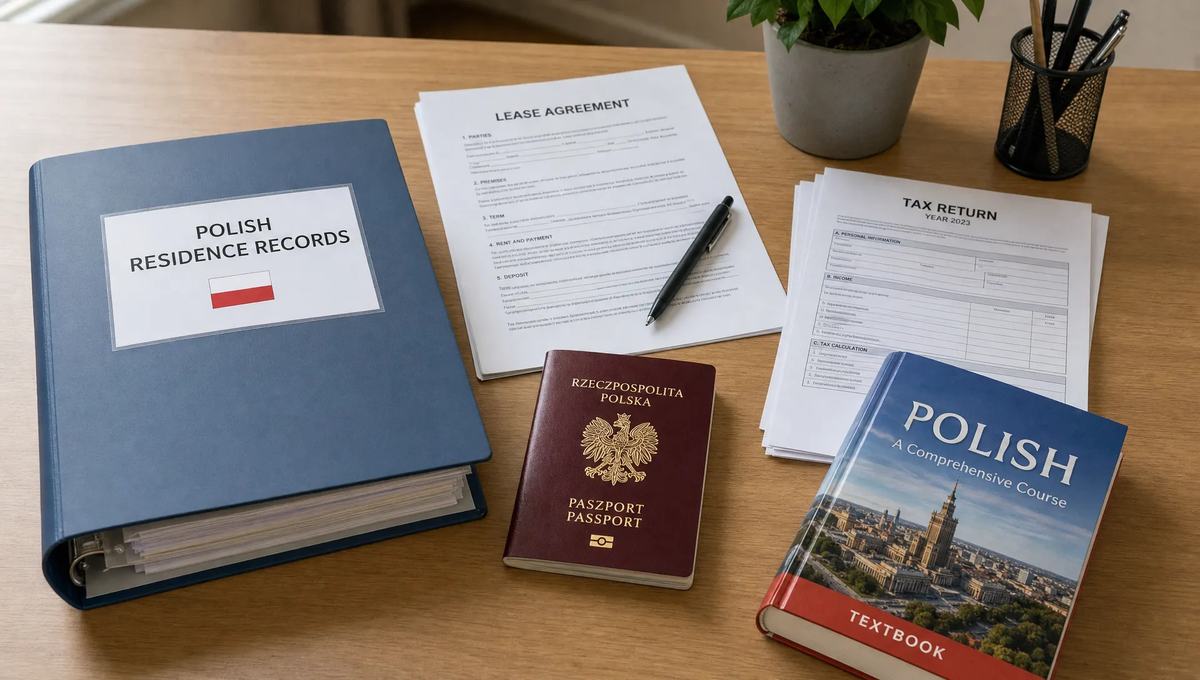
Common documents include:
- Valid passport and copies of previous passports covering relevant residence periods
- Residence cards and residence decisions
- Full birth certificate, and marriage or divorce documents if relevant
- Proof of legal title to accommodation, such as a lease or ownership document
- Employment contracts, B2B contracts, invoices, PIT tax returns and ZUS records where relevant
- Proof of stable and regular income
- Polish language certificate or accepted education records
- Travel history and evidence explaining longer absences
- Sworn translations of foreign documents into Polish
- Apostilles or legalization for foreign civil status records where required
If you are self-employed, tidy business records matter. Keep CEIDG or company registration, client contracts, bank statements, tax filings and supplier invoices in a consistent archive. For example, if you run a small apparel or merch business, paperwork from custom woven labels providers should sit with your other commercial records. It does not prove citizenship by itself, but organized records make income and business activity easier to explain.
Tax also matters more than many new arrivals expect. If you plan to work remotely for UK clients while living in Poland, sort out your residence and tax position early rather than trying to repair it later. Move2Poland’s guide to tax in Poland for UK remote workers explains the issues to understand before you move.
What can slow down or weaken a citizenship application?
Citizenship problems often begin years before the application. A move that feels informal at the start can create gaps that are hard to explain later.
The most common issues are missing residence records, long absences from Poland, late tax registration, inconsistent names across documents, expired passports, weak evidence of income and no official Polish language certificate. Descent cases have their own problems, especially missing archive records and events that may have caused an ancestor to lose citizenship under older laws.
A criminal record or ongoing legal issue can also affect the assessment. So can security concerns or information requested from other authorities. If your situation is sensitive, do not rely on general blog advice. Get professional legal help before filing.
Does Poland allow dual citizenship?
Polish law does not generally require a UK citizen to give up British citizenship when becoming Polish. The UK also allows dual citizenship, so British-Polish dual nationality is common.
The practical catch is that Poland treats a Polish citizen as Polish when dealing with Polish authorities. You should not expect to rely on British citizenship to avoid Polish legal obligations while in Poland. Polish citizens are also generally expected to use Polish documents when entering or leaving Poland.
If you hold citizenship of another country besides the UK, check that country’s rules. Some countries restrict or penalize dual citizenship.
Is Polish citizenship worth it?
For some people, yes. Polish citizenship gives you the security of full membership in Poland, the right to vote in relevant elections, access to a Polish passport and EU citizenship rights. It can make life simpler if Poland is truly your long-term home.
But citizenship is not a substitute for deciding whether you actually want to live in Poland. The language, bureaucracy, winter, work culture and family logistics all matter. If you are moving with children, a partner or a remote job, those day-to-day questions come long before the passport.
Treat citizenship as a long-term outcome, not the first milestone. The first milestone is building a legal, financially stable and realistic life in Poland.
Frequently Asked Questions
Can UK citizens get Polish citizenship? Yes. UK citizens can get Polish citizenship if they qualify through descent, recognition after residence, marriage-based recognition, presidential grant, restoration or another special route. For most UK movers without Polish roots, it is a long-term residence path rather than a quick application.
How long do I need to live in Poland before applying for citizenship? It depends on the route. A standard resident may need about 8 years from moving to Poland before being eligible, while a spouse of a Polish citizen or someone with Polish origin may have a shorter route. Descent cases are different because you may already be Polish if the citizenship line is intact.
Do I need to speak Polish to become a citizen? Most adult applicants applying through recognition need official proof of Polish at B1 level or an accepted education certificate. Presidential grants are discretionary and not tied to the same statutory language rule, but language ability can still support the overall case.
Does marrying a Polish citizen automatically give me citizenship? No. Marriage to a Polish citizen does not automatically grant citizenship. It may shorten the recognition route, but you still need the required marriage duration, qualifying residence status, continuous residence and language proof where applicable.
Can I keep my British passport if I become Polish? In most cases, yes. The UK allows dual citizenship, and Poland does not generally require UK citizens to renounce British citizenship. In Poland, however, Polish authorities will treat you as a Polish citizen.
Is Polish citizenship by descent faster than naturalization? It can be, but only if the documents support an unbroken citizenship line. Some descent cases are straightforward, while others take years because of missing records, name changes or historical citizenship loss questions.
Need help deciding where citizenship fits into your Poland plan?
If you are still deciding whether Poland is right for you, do not start with the passport question alone. Start with residence, taxes, city choice, cost of living, family needs and whether day-to-day life in Poland suits you.
Move2Poland helps UK citizens and families make that decision with practical relocation guidance, discovery calls, planning support and on-the-ground orientation in Wrocław. If citizenship is your long-term goal, the best first step is building a clean, realistic move from day one.