
Tax in Poland for UK Remote Workers: What You Need to Understand Before Moving
Planning to work remotely from Poland while keeping UK income? This guide explains the tax residence, treaty, payroll and social-security questions to resolve before you move.
By Move2Poland··Updated 17 September 2026
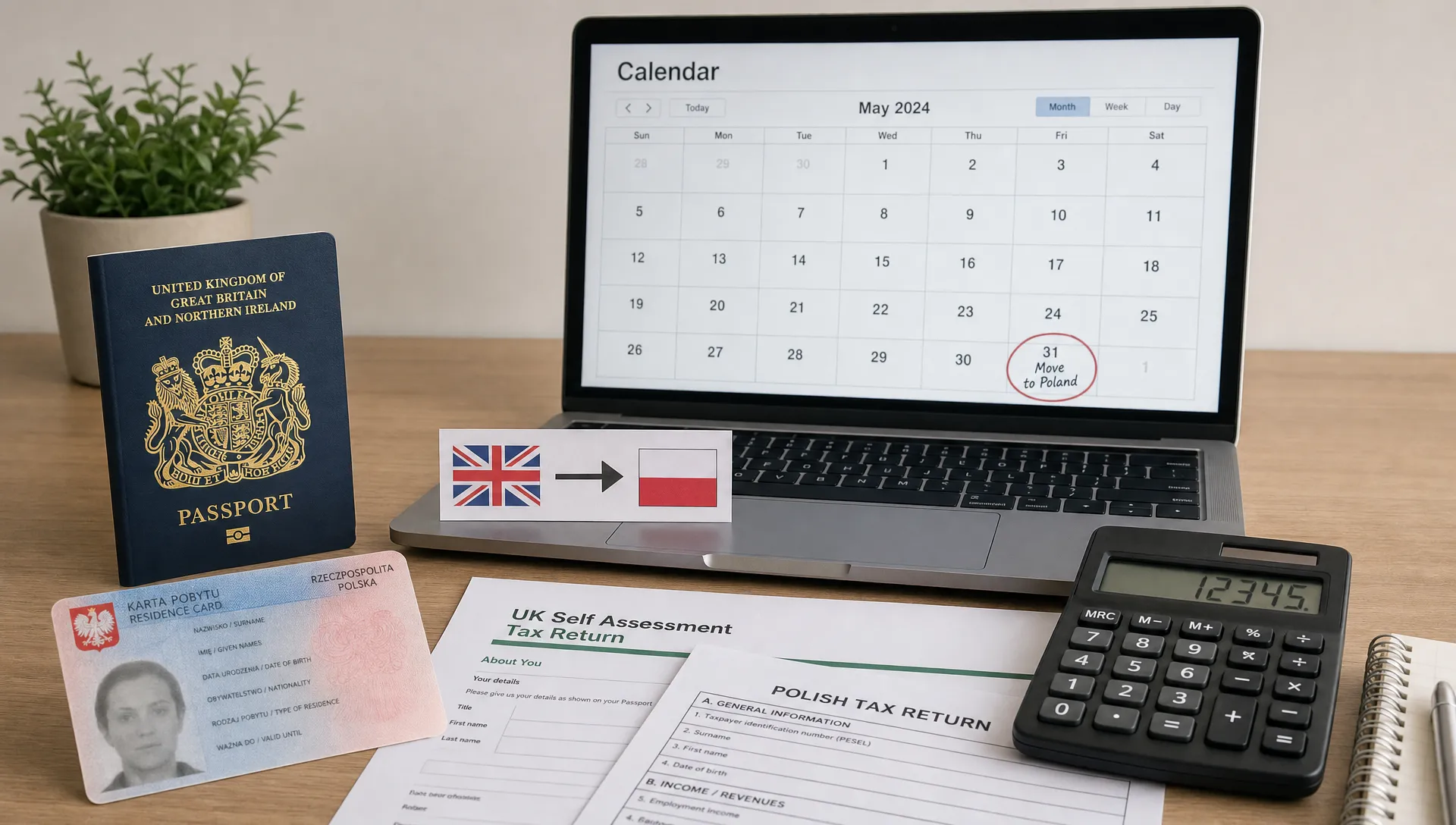
For many UK professionals, Poland is appealing because it offers strong city life, relatively good connectivity, and a lower cost base than London or much of the South East. But if you plan on working remotely from Poland while keeping UK income, tax should not be treated as an afterthought.
The biggest mistake is assuming that tax in Poland for UK remote workers comes down to one simple test: stay under 183 days and you are fine. Day counts can matter, but they are not the whole answer. Polish tax residence, UK tax residence, the UK-Poland double taxation treaty, employment law, payroll, social security and your employer or company structure can all affect the outcome.
This article is not a filing guide and it does not provide personalised tax advice. Its purpose is to help you understand the questions you need to resolve before you move, so you can decide whether Poland works for your life, career and financial position.
First, separate three different permissions
Before looking at tax rules, separate immigration permission, employer permission and tax treatment. They are connected in practice, but they are not the same thing.
| Question | What it decides | What it does not decide | |---|---|---| | Can I legally live in Poland? | Your immigration and residence rights as a UK citizen or family member | Whether your income is taxable in Poland | | Can I work remotely from Poland for my employer or clients? | Whether your contract, employer policy or client arrangement allows remote work abroad | Whether Polish payroll, tax or social-security obligations arise | | Where am I tax resident, and where is my work taxed? | Which country can tax which income, and how double taxation is handled | Whether your employer is comfortable with the arrangement |
Since Brexit, UK citizens are generally treated as third-country nationals for Polish immigration purposes. If you have not yet dealt with the residence side of the move, start with the practical implications in the Post-Brexit visas guide for UK citizens moving to Poland. A valid immigration route is essential, but it does not automatically answer your tax position.
How Polish tax residence works
Poland taxes individuals differently depending on whether they are Polish tax residents or non-residents. According to the Polish Ministry of Finance guidance on tax residence in Poland, an individual can be treated as resident in Poland if they have their centre of personal or economic interests in Poland, or if they stay in Poland for more than 183 days in a tax year.
The word or matters. The 183-day rule Poland is often discussed as if it were a safe harbour. It is not. You may spend fewer than 183 days in Poland and still need to examine whether your centre of personal or economic interests has moved there.
Personal interests can include where your home life, partner, children, social life and day-to-day base are located. Economic interests can include where you earn income, run business activity, manage assets, hold professional relationships or conduct regular work. No single factor is always decisive, and the overall picture matters.
If you become Polish tax resident, Poland may tax your worldwide income under its domestic rules, subject to treaty relief where another country also has taxing rights. If you are not Polish tax resident, Poland may still tax certain Polish-source income. For remote workers, the key question is often whether work physically performed in Poland creates Polish taxing rights even where the employer, client or bank account is in the UK.
UK tax residence can still matter after you leave
Leaving the UK does not automatically mean you stop being UK tax resident. HMRC applies the Statutory Residence Test, which considers UK days, automatic residence and overseas tests, work patterns and UK ties. The official HMRC guidance is set out in RDR3, Statutory Residence Test.
For a UK remote worker moving to Poland, this means two things. First, you may remain UK tax resident for at least part of the year depending on your circumstances. Second, even if you eventually become non-resident, UK-source income, UK property, pensions, dividends or company interests may still need separate review.
This is why Poland tax residency UK questions are rarely solved by booking a one-way flight. Your move date, UK visits, ongoing UK workdays, family position, accommodation and business interests can all affect the analysis.
The UK-Poland double taxation framework
The UK and Poland have a double taxation convention, available through GOV.UK’s page on Poland tax treaties. A double tax treaty does not mean you can choose where to pay tax, and it does not mean income is only ever taxed in one country at the start of the process.
Instead, the treaty helps decide which country has taxing rights over particular types of income and how double taxation should be relieved where both countries are involved. It also contains tie-breaker rules for cases where both countries treat the same person as tax resident under their domestic laws.
For employment income, a core concept is where the employment is exercised. If you are physically working in Poland, that fact can be relevant even if your employer is British, your employment contract is governed by UK law, your salary is paid in sterling, and your manager sits in Manchester or London.
There are treaty exceptions and conditions that may matter, including day counts and who economically bears the employment cost. But those conditions need to be applied to your facts. They should not be reduced to a blanket statement that under 183 days equals no Polish tax.
Employment income earned while physically working in Poland
A UK employee working from Poland tax question is not only about the employee’s personal tax return. The employer may also need to consider whether it has Polish payroll, withholding, employment law, social-security or corporate tax exposure.
For example, if a UK employer allows an employee to relocate full-time to Poland, the employer may need advice on whether salary should be reported or withheld through a Polish process, whether Polish social-security contributions are due, and whether the employee’s activities create any local corporate tax risk for the company. That risk is usually higher where the employee is senior, negotiates contracts, manages people, or represents the company commercially from Poland.
This does not mean every remote-working arrangement creates a major problem. It means employer permission should be informed permission. A line manager saying yes to remote work abroad is not the same as HR, payroll, tax and legal teams confirming the arrangement is compliant.
Social security is separate from income tax
Income tax and social security are often discussed together, but they follow different rules. The UK has official guidance on National Insurance when you go abroad, and cross-border arrangements can depend on whether someone is posted temporarily, works in more than one country, or has relocated on a more permanent basis.
For a long-term move to Poland, Polish social-security contributions may become relevant, especially where the work is genuinely being performed from Poland. In other cases, a temporary posting or multi-country work pattern may require a different analysis. The important point is that income tax residence does not automatically settle social security, and social security does not automatically settle income tax.
From a planning perspective, this matters because social-security contributions can affect net pay, employer cost, benefits, pension records and the employer’s willingness to approve the arrangement.
Employees, consultants and business owners face different issues
Remote work Poland tax questions vary significantly depending on how you earn your income. A salaried employee, a self-employed consultant and a company owner can all be working from the same apartment in Wrocław, but the tax questions may be quite different.
| Profile | Main questions to resolve | Why it matters before moving | |---|---|---| | UK employee relocating to Poland | Polish and UK tax residence, treaty treatment of employment income, payroll, social security and employer approval | The employer may have obligations, not just the employee | | Consultant or freelancer splitting time | Residence, source of income, where services are physically performed, invoicing structure and possible business obligations | Client location alone does not decide where income is taxed | | Business owner or director working from Poland | Personal residence, company management, permanent establishment risk, salary, dividends and social security | Personal relocation can affect both the individual and the business |
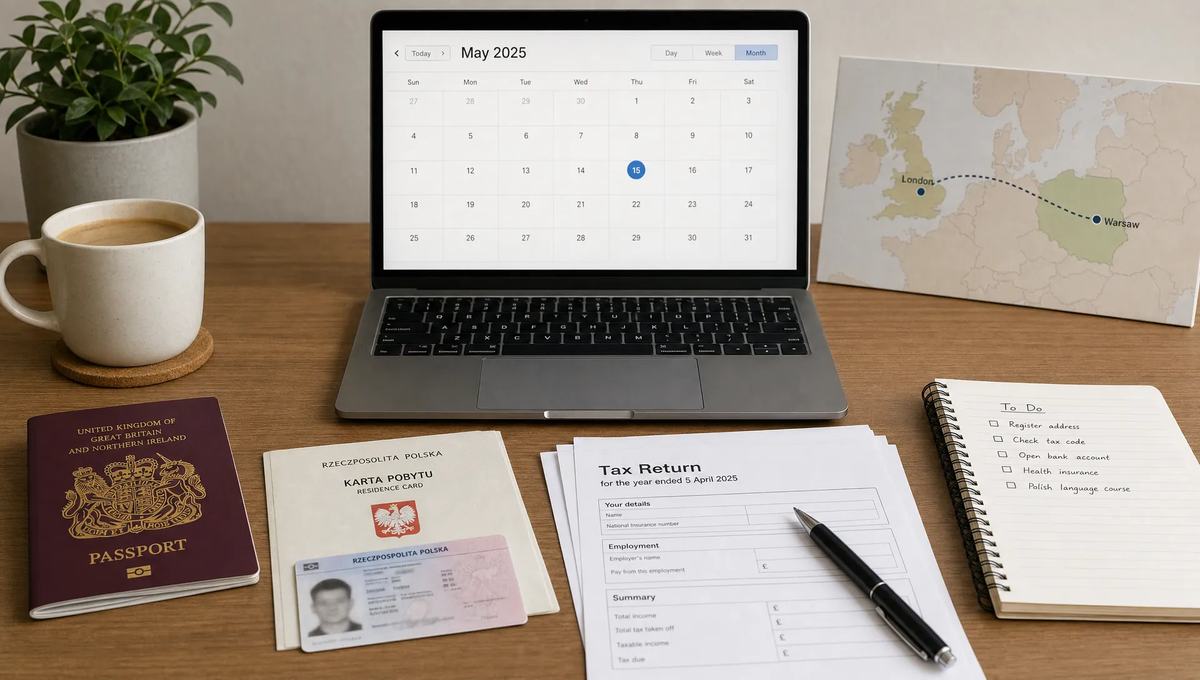
Scenario 1: a UK employee relocating full-time to Poland
Imagine a software manager employed by a UK company who wants to move to Gdańsk permanently while keeping the same job. They plan to rent out their UK flat, move with their partner and work from Poland five days a week.
In this scenario, the 183-day count is relevant, but it is not the only issue. Their centre of personal and economic interests may be moving to Poland. Their UK tax residence may continue for part of the transition year. Their employment income is being earned while physically working in Poland. Their employer may need to review payroll and social-security obligations.
The key decision is not whether the person likes Gdańsk or whether the job can technically be done on a laptop. The key decision is whether the employment arrangement can be made compliant and commercially acceptable for both employee and employer.
Scenario 2: a consultant splitting time between the UK and Poland
Now imagine a self-employed consultant who spends spring and summer in Poland, returns to the UK regularly for client meetings, and works with clients in the UK, EU and US. They rent a flat in Kraków but keep accommodation available in the UK.
Here, day counting becomes more important, but it still does not answer everything. The consultant needs to consider where they are resident under Polish and UK rules, where their services are physically performed, how often they work in each country, and whether any treaty provisions affect the result.
This type of arrangement can look flexible from a lifestyle perspective, but it can become messy if records are poor or assumptions are made informally. A consultant should usually take advice before building a recurring cross-border pattern, especially if their income is significant or clients require tax residency confirmations.
Scenario 3: a business owner working from Poland
A UK company owner or director faces another layer of complexity. If they move to Poland but continue making strategic decisions, negotiating contracts, managing teams or running the company from Poland, the question is not limited to their personal tax residence.
The company may need advice on whether the owner’s activities create a taxable presence in Poland, whether central management questions arise, and how remuneration is treated. Salary, dividends, director fees and retained profits may all raise different questions.
For founders and owner-managed businesses, this is one of the most important areas to review before relocating. The answer may still be manageable, but it should not be discovered after the move has already happened.
Common assumptions that cause problems
Many UK professionals approach tax in Poland for UK remote workers with reasonable but incomplete assumptions. The better approach is to turn each assumption into a question.
| Assumption | Better question | |---|---| | I will stay under 183 days, so Poland cannot tax me | Could I still be Polish tax resident because my centre of interests is in Poland? | | My employer is in the UK, so it is UK-only tax | Where is the employment physically exercised, and what does the treaty say? | | I am paid into a UK bank account, so Poland is irrelevant | Does the payment location change the taxing rights? Usually, it is only one fact among many | | My employer approved remote work, so tax is settled | Did payroll, HR, legal and tax teams review the arrangement? | | My visa or residence card decides my tax residence | Immigration status and tax residence are separate questions |
The aim is not to make the move feel impossible. It is to avoid building your relocation plan around a rule of thumb that was never designed to cover your full situation.
Build tax into the wider relocation decision
Tax affects more than annual paperwork. It can change your monthly net income, employer cost, mortgage capacity, pension planning and the realistic budget you have for housing, schools, travel and family life.
This is why tax should sit alongside city choice and cost planning, not behind them. If you are still comparing Polish cities and household budgets, the 2026 cost of living guide for expats in Poland is a useful companion to the tax questions in this article.
The same principle applies to wider financial commitments. If a relocation affects property, refinancing or lending decisions in another country, using clear professional guidance can prevent expensive assumptions. For example, the value of smart mortgage solutions is that major financing decisions are easier to make when rates, documents and personal circumstances are reviewed clearly rather than guessed.
For a move to Poland, the tax equivalent is simple: do not wait until after arrival to find out whether your work arrangement, company structure or UK ties create obligations you did not budget for.
What to clarify before committing to the move
At decision level, the questions to resolve are straightforward, even if the answers require professional advice.
You need to know whether you are likely to become Polish tax resident, whether you may remain UK tax resident, how the UK-Poland treaty applies to your income, whether your employer or company has obligations, and how social security should be handled. You also need to know whether the after-tax position still supports the lifestyle you want in Poland.
What you should avoid is trying to reverse-engineer the answer from internet comments, digital nomad forums or someone else’s situation. A single person doing contract design work for three months in Warsaw is not in the same position as a married UK director moving permanently to Wrocław with children and a UK limited company.
Frequently Asked Questions
Does staying under 183 days mean I owe no tax in Poland? No. The 183-day rule is important, but it is not a universal safe harbour. Polish tax residence can also depend on whether your centre of personal or economic interests is in Poland.
Can I be tax resident in both the UK and Poland? Yes, it is possible for both countries to treat you as tax resident under their domestic rules. The UK-Poland double taxation convention then needs to be considered to determine treaty residence and relief from double taxation.
If my UK employer pays me in the UK, can Poland still tax the income? Potentially, yes. For employment income, where the work is physically performed can matter. A UK payroll, UK contract or UK bank account does not automatically prevent Polish tax questions from arising.
Does my Polish residence permit decide my tax residence? No. Immigration residence and tax residence are separate. A legal right to live in Poland does not automatically determine where your income is taxed.
Do freelancers have simpler rules than employees? Not necessarily. Freelancers avoid some employer payroll questions, but they may face their own issues around tax residence, where services are performed, business obligations, invoicing and social security.
Should I get professional tax advice before moving? If you will keep UK employment, run a business, own a company, split time between countries or have significant UK assets, individual advice is strongly recommended. This article helps you identify the questions, not calculate or file your position.
Make tax part of your relocation sequence
Tax is one part of a wider decision: whether Poland is right for your work, family, finances and tolerance for bureaucracy. The safest approach is to organise the sequence before you commit, not after your lease is signed and your employer has already approved an informal arrangement.
The Move2Poland Decision Guide is designed to help you structure that decision clearly, including work, residence, city choice, cost of living and the practical realities of settling in Poland. Use it to organise the move, then bring in qualified tax advice where your personal facts require it.