
Moving to Poland After Brexit: What Changed for British Citizens?
Brexit changed the legal starting point for British citizens planning a move to Poland. This guide explains what changed, why old advice can mislead and what you should clarify before committing.
By Move2Poland··Updated 17 September 2026

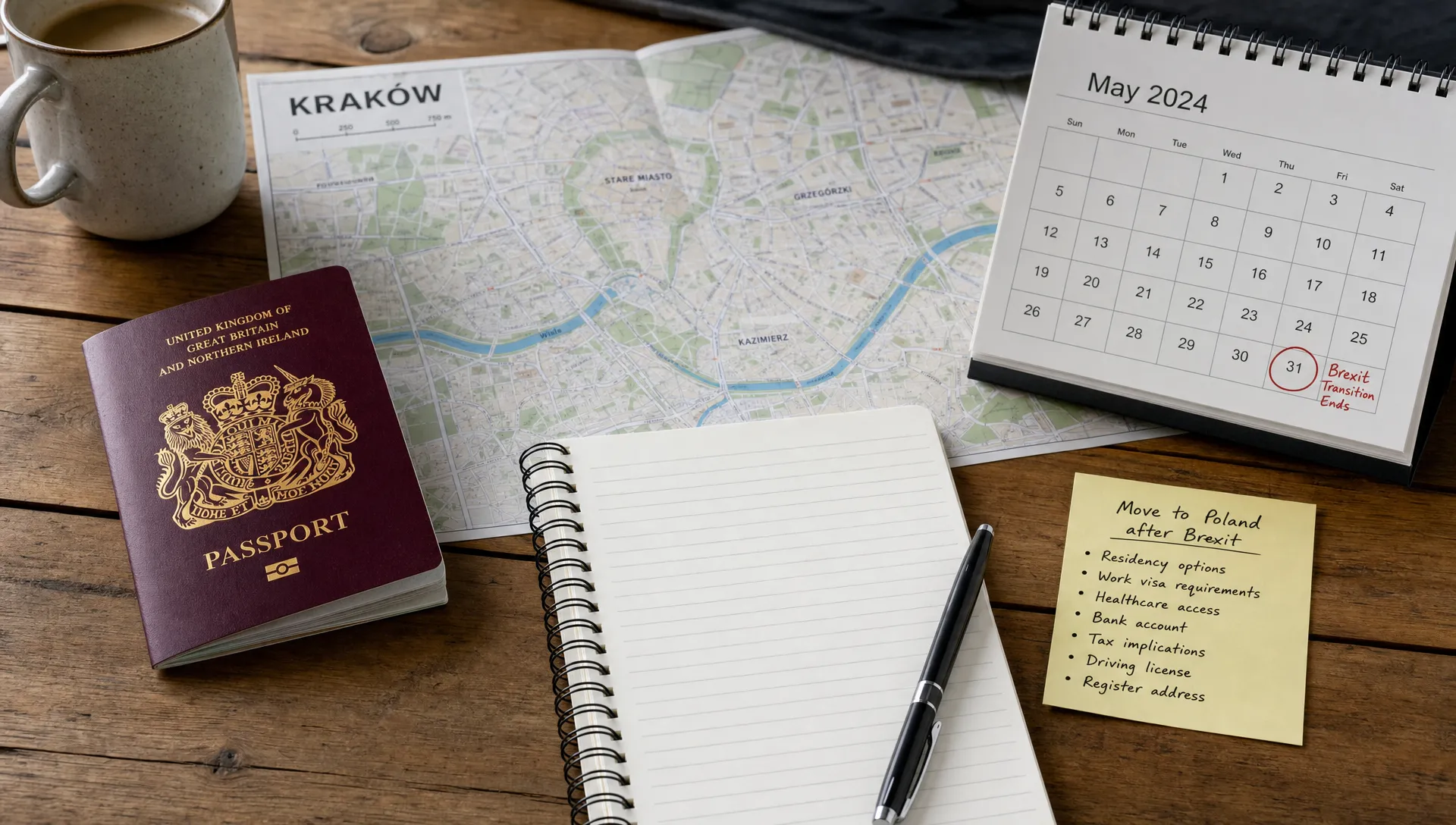
Brexit changed the legal starting point for British citizens who want to live in Poland. It did not close Poland to British movers, but it did end the assumption that a UK passport carries EU freedom-of-movement rights.
That distinction matters. A British citizen who was already legally resident in Poland before the end of the Brexit transition period may be in a very different position from a British citizen who is planning a move now. If you are considering moving to Poland after Brexit, your first question is no longer simply whether you like the country, the cost of living or the city. It is whether you have a legal basis to stay, work and access healthcare beyond a short visit.
This article explains the landscape at a high level. It is not a Karta Pobytu application manual and it should not replace official guidance or individual legal advice. The aim is to help you understand what changed, why older advice can be misleading and what you need to establish before making practical commitments.
The core change: British citizens are no longer EU movers
Before Brexit, British citizens moving to Poland could generally rely on EU free movement. That meant the legal framework was designed around the right of EU citizens to enter, live and work in another EU member state, subject to registration requirements and specific conditions.
That position changed after the UK left the EU and the transition period ended on 31 December 2020. The UK government’s Living in Poland guidance and the Polish Office for Foreigners Brexit guidance both distinguish between people whose rights may be protected under the Withdrawal Agreement and people moving later under ordinary immigration rules.
In practical terms, this creates two broad categories.
| Category | Broad position | Why it matters | |----------|----------------|----------------| | British citizens lawfully resident in Poland before the end of the transition period | May have residence rights protected under the Withdrawal Agreement, provided they meet the relevant conditions | Their paperwork and rights can differ from those of new arrivals | | British citizens moving to Poland after the transition period | Treated as non-EU nationals for residence and work purposes | They need a valid legal basis for longer stays and cannot rely on EU free movement |
Most readers planning a move today fall into the second category. That does not mean Poland is off limits. It means your move needs to be planned through the post-Brexit rules that apply to non-EU nationals.
Why protected Withdrawal Agreement residents are different
The Withdrawal Agreement was designed to protect certain rights of UK nationals and their family members who were already living in an EU member state before the end of the transition period. In Poland, this mainly concerns British citizens who established lawful residence before 1 January 2021 and continued to meet the relevant conditions.
If someone moved to Poland in 2018, registered under the pre-Brexit system and remained resident, their situation may still be governed by rules connected to that earlier status. Their advice may be genuine, well meant and accurate for them. It may still be wrong for you.
This is one of the most common traps for British movers. A forum post from a long-term British resident might say that they only had to register their stay, exchange a document or deal with a certain office in a particular way. That person may have been living in Poland under EU free-movement rules before Brexit. A British citizen arriving now does not inherit that position.
If you are moving to Poland after Brexit, ask whether the advice you are reading was written for:
- A British citizen already resident in Poland before 2021
- A family member of a protected resident
- A British citizen moving now with no prior Polish residence rights
- An EU citizen from another member state, rather than a UK citizen
Those are not small technical differences. They can affect your right to stay, your ability to work and the documents you need to hold.
What you can usually do as a short-term visitor
British citizens can visit Poland and other Schengen area countries without a visa for short stays, normally up to 90 days in any 180-day period. The UK government’s Poland entry requirements explain the short-stay Schengen rules, including how days in other Schengen countries can count towards the same limit.
This short-stay permission is useful for research trips, viewing neighbourhoods, meeting estate agents, visiting family or testing whether daily life in Poland feels realistic. It is not the same as residence. It does not, by itself, give you an open-ended right to settle in Poland and it should not be treated as permission to take up employment.
For prospective movers, the 90-day rule is best understood as a planning window, not a relocation strategy. It can help you explore cities, attend meetings and get a feel for the country, but your longer-term plan needs a separate legal basis.
If you want a wider overview of how post-Brexit entry and residence routes fit together, Move2Poland has a separate guide to post-Brexit visas for UK citizens moving to Poland. This article stays at the strategic level so you can understand the implications before getting lost in forms.
Staying longer term requires a recognised basis
For a British citizen moving now, wanting to live in Poland is not enough on its own. Longer-term residence generally has to connect to a recognised purpose, such as work, business activity, studies, family circumstances or another basis provided by Polish law. The Polish Office for Foreigners sets out the broad framework for temporary residence permits, including the principle that temporary residence is connected to the circumstances justifying the stay.
This is where many people confuse the document with the right. A Karta Pobytu, or residence card, is commonly discussed online as if it were the route itself. In reality, it is evidence of a residence status. The more important question is what legal basis sits behind it.
For example, two British citizens may both end up holding residence cards, but for different reasons. One might be employed by a Polish company. Another might be studying. Another might be in Poland because of family circumstances. The plastic card may look similar, but the conditions behind it are not interchangeable.
That is why your planning should start with the basis for residence, not with the name of the document. If your plan depends on employment, the employment structure needs to make sense. If it depends on running a business, that raises a different set of questions. If it depends on remote work for a UK employer, immigration, tax, social security and healthcare all need to be considered together.
The right to work is a separate practical issue
One of the biggest post-Brexit changes is psychological as much as legal. British citizens were used to thinking of Poland as part of a European labour market they could enter freely. That is no longer the correct assumption.
Polish government business guidance explains that a foreigner’s work in Poland generally depends on both legal stay and a right to work, often involving a work permit unless an exemption applies. The official biznes.gov.pl guidance on employing foreigners is a useful starting point for understanding the employer-side logic, although your own circumstances may require specialist advice.
This matters whether you intend to work for a Polish employer, transfer within a company, freelance, set up a business or work remotely. The immigration question is not just, Can I enter Poland? It is, Can I lawfully carry out the work I plan to do while living there?
For British engineers, project managers and technical specialists, cross-border work can make this especially easy to misunderstand. A role with a European technical service provider, such as BKL’s engineering work in mechanics and mechatronics, may involve clients, sites or projects in more than one country. Even then, the relevant immigration, employment and tax questions depend on where you live, where you physically work, who employs you and how you are paid.
Healthcare planning changed too
Healthcare is another area where pre-Brexit habits can cause confusion. A UK-issued GHIC or EHIC may help with medically necessary treatment during a temporary stay, but it is not a substitute for healthcare cover when you move abroad to live. The UK government’s official healthcare in Poland guidance explains how access can differ for visitors, workers, pensioners and people with specific entitlements such as an S1.
If you are planning to live in Poland, healthcare should be linked to your residence and work plan. Some people access the Polish public system through employment and social security contributions. Some may need private cover for a period. Some may have UK-linked entitlements depending on their circumstances. The correct answer depends on the whole structure of your move.
This is not just an administrative detail. If your Polish residence plan, work arrangement and healthcare cover do not line up, you may find yourself dealing with avoidable gaps. For a more practical look at expectations, public and private options and common misconceptions, see Move2Poland’s guide to healthcare in Poland for British expats.
Why old forum posts can be actively misleading
Online relocation advice has a long shelf life. Unfortunately, immigration rules do not.
A British resident who moved before Brexit may talk about Poland as if the process still works like an EU move. A post from 2016 might mention registration rules that applied to EU citizens. A comment from 2020 might have been written during the transition period. A Facebook answer might be from someone covered by the Withdrawal Agreement, even if they do not mention it.
This does not mean you should ignore all lived experience. Practical comments about neighbourhoods, winter weather, supermarket prices or tram etiquette can still be useful. Legal claims need a higher standard. If the advice concerns residence, work permission, border limits or healthcare entitlement, check it against current official sources.
A good rule is to separate lifestyle advice from legal advice. Lived experience can tell you what a city feels like. It cannot reliably tell you what status you personally need in 2026.
What should you establish before planning your move?
Before you book movers, sign a long lease or resign from a UK job, you need to resolve the core questions. You do not need to know every procedural detail at the beginning, but you do need a coherent picture of your legal and practical position.
| Question | Why it matters | |----------|----------------| | Are you covered by the Withdrawal Agreement? | Most new movers are not, but the distinction changes the legal framework completely | | How long do you intend to stay at first? | A short exploratory visit and a genuine move are treated differently | | What is your basis for longer-term residence? | Employment, business, study, family and other circumstances lead to different routes | | What gives you the right to work? | Entry as a visitor is not the same as permission to work | | How will healthcare be covered? | Your answer may depend on employment, contributions, private cover or UK-linked entitlement | | Where will you be tax resident? | Residence, work location and income source can have consequences in both countries | | Which city actually fits your life? | Legal permission gets you into Poland, but daily life depends on housing, language, schools, transport and work patterns |
These questions are deliberately not a document checklist. At this stage, the goal is to avoid building a move on assumptions that no longer apply.
Think in systems, not isolated tasks
A post-Brexit move to Poland works best when the pieces are considered together. Residence affects work. Work affects tax and healthcare. Healthcare may depend on employment status. City choice affects housing costs and whether your income feels comfortable. Schooling, language and family needs can change the timeline.
This is why starting with paperwork alone can be frustrating. You may spend hours reading about residence cards before answering the more important question: what is the actual structure of your life in Poland going to be?
For example, a remote worker employed by a UK company has a different planning problem from someone hired locally in Warsaw or Wrocław. A family with school-age children faces different timing pressures from a single person testing the move for six months. A retiree with possible UK healthcare entitlements has different questions from a contractor setting up a Polish business.
None of these situations is automatically impossible. They simply need to be organised before you commit.
The practical takeaway for British citizens
If you are moving to Poland after Brexit, the main change is not that Poland has become unreachable. It is that the legal default has changed.
You can no longer assume that a British passport gives you the EU citizen’s right to live and work in Poland. You need to identify the basis for your stay, understand whether and how you can work, plan healthcare properly and treat old pre-Brexit advice with caution.
At the same time, this should not be approached with panic. Many British citizens still move to Poland successfully. The difference is that good planning now starts earlier. You need to know which questions apply to you before you make financial and family decisions.
Frequently Asked Questions
Can British citizens still move to Poland after Brexit? Yes, British citizens can still move to Poland, but they cannot rely on EU freedom-of-movement rights. A longer-term move normally requires a recognised legal basis under Polish rules, such as work, study, family circumstances or another qualifying purpose.
Does the Withdrawal Agreement help me if I am moving now? Usually not. The Withdrawal Agreement mainly concerns UK nationals and eligible family members whose Polish residence was established before the end of the Brexit transition period and who meet the relevant conditions. New movers generally fall under the rules for non-EU nationals.
Can I use the 90-day visa-free period to live in Poland? The visa-free Schengen allowance is for short stays, normally up to 90 days in any 180-day period. It can be useful for research and preparation, but it is not a long-term residence plan and does not automatically allow work.
Is a Karta Pobytu the same as permission to live in Poland? Not exactly. A Karta Pobytu is a residence card that evidences a status. The key issue is the legal basis behind that status, such as employment, study, family or another recognised reason.
Can I work remotely from Poland for a UK employer? Possibly, but it needs careful analysis. Immigration status, right to work, tax residence, payroll, social security and healthcare may all be relevant. Do not assume that remote work avoids Polish legal considerations simply because your employer or clients are in the UK.
Ready to organise your actual move?
Once you understand the post-Brexit landscape, the next step is to turn it into a practical plan. The Move2Poland Decision Guide is designed for British citizens who need to connect the big questions: residence assumptions, work, tax, healthcare, city choice, budget and timing.
If Poland is still on your shortlist, use the guide before you commit to a lease, job change or full relocation. It will help you move from scattered information to a clearer decision about whether Poland is right for you and what needs to be resolved first.