
How EU Citizen Registration in Poland Works After Arrival
Moving on an EU passport? Learn when to register your stay, which documents to prepare and where to apply. Keep residence registration, address registration and PESEL separate so your arrival paperwork stays manageable.
By Move2Poland·
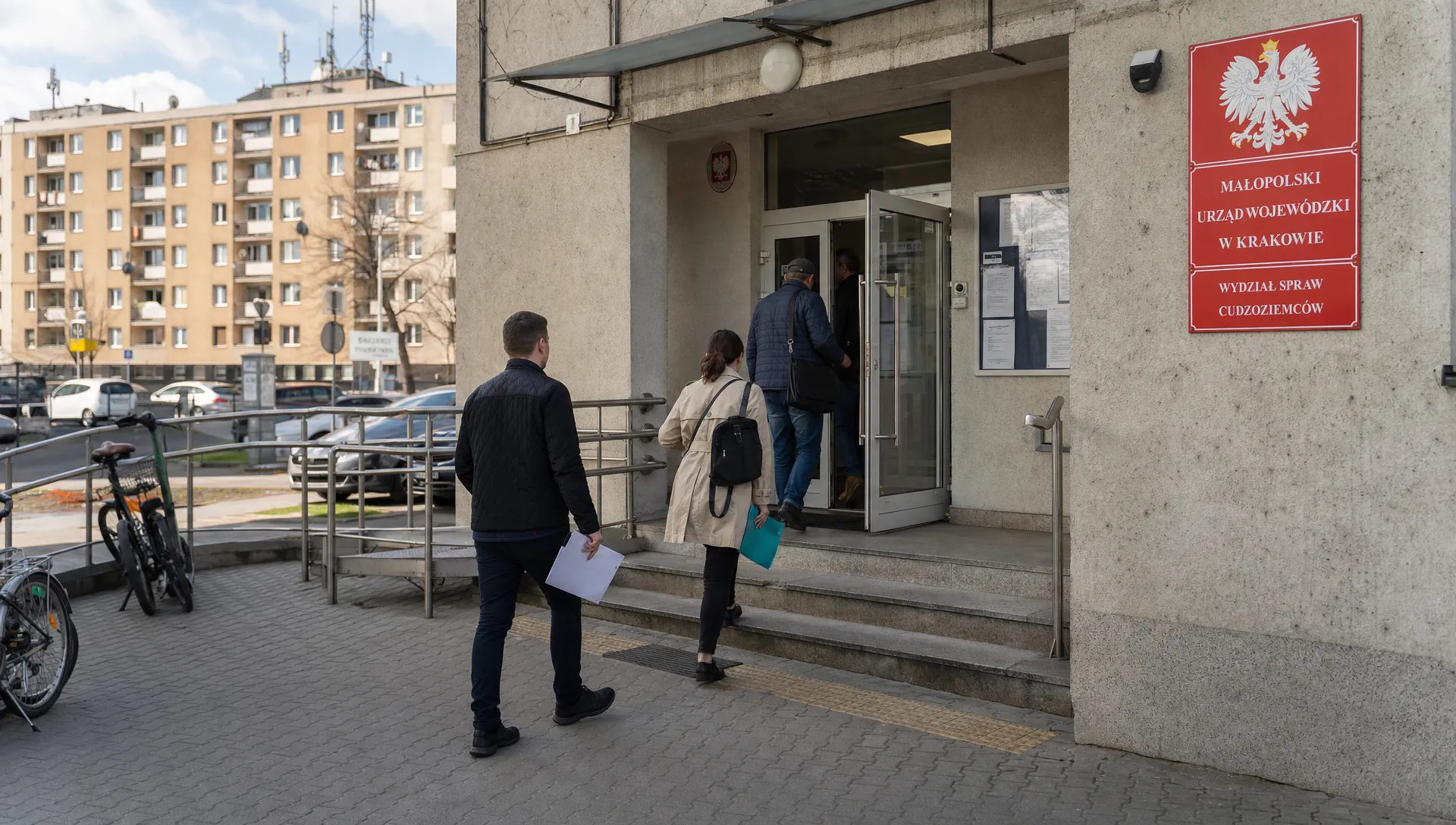
EU citizen registration in Poland is the process for documenting your right to live in Poland when your stay extends beyond three months. It is not a visa application, a work permit or the same thing as registering your address.
For most EU nationals, the practical task is to establish your residence basis, prepare the supporting documents and apply to the provincial authority responsible for where you live. The main risks are missing the deadline or confusing this process with other arrival paperwork.
This guide explains who needs to register, what you will usually need and how the process fits alongside meldunek and PESEL.
Who needs to register their stay?
If you hold citizenship of another EU country and move to Poland for more than three months, you generally need to register your residence. The corresponding framework also covers nationals of Norway, Iceland, Liechtenstein and Switzerland.
For an initial stay of up to three months, an EU citizen generally needs a valid passport or national identity card rather than a Polish visa or residence permit. You can also work in Poland without obtaining a work permit.
There is a specific exception for genuine jobseekers. They can generally stay without registration for up to six months and longer if they demonstrate that they are actively seeking work and have a genuine chance of being employed. Do not treat this exception as a general extension for anyone who has not prepared their paperwork.
What if you are moving from the UK?
Your citizenship matters more than the country you are moving from. A British-Irish dual national moving on their Irish citizenship can use the EU route. A British citizen without EU citizenship generally cannot.
People protected by the Brexit Withdrawal Agreement have a separate framework. For new arrivals using only British citizenship, our guide to post-Brexit visas and residence arrangements explains the different route.
EU citizen registration in Poland also does not automatically cover a spouse who holds only a non-EU passport. That person may need a residence card as the family member of an EU citizen.
EU citizen registration in Poland: the three-month deadline
For the standard registration route, you must submit your application no later than the day following the end of the three-month period from your entry into Poland.
This is a three-month residence rule, not the Schengen 90-days-in-180-days calculation used for many non-EU visitors. Avoid substituting a tourist-stay calculator for the registration deadline.
The Polish Office for Foreigners’ registration guidance explains the national requirements. Your local voivodeship office provides the application instructions and document checklist for submission.
Start gathering evidence before the deadline approaches, particularly if you need insurance documents, translated certificates or an appointment. An appointment reservation is not necessarily the same as submitting an application.
Registration documents an existing right of residence under EU rules. It does not create that right independently of your circumstances. Equally, missing the administrative deadline does not automatically turn an otherwise qualifying EU citizen into someone who needs a visa. It can still expose you to penalties and should be addressed promptly.
Establish the basis for your residence
Before collecting documents for EU citizen registration in Poland, identify the category that actually describes your situation. Having an EU passport establishes your citizenship, but residence beyond three months normally requires an additional qualifying basis.
Employment or self-employment
Working in Poland or being self-employed is a common basis. Depending on your circumstances, supporting evidence may include an employer’s confirmation, an employment contract or documents showing your business activity.
Your right to work does not depend on receiving the registration certificate first. However, having a job does not remove the obligation to register a longer stay.
If you have recently lost employment or cannot work temporarily, EU rules can preserve worker status in certain circumstances. Get advice on that situation rather than assuming you must immediately switch to the financially self-sufficient route.
Sufficient resources, study and health insurance
If you are not relying on worker or self-employed status, you will generally need to demonstrate sufficient resources and appropriate health insurance. Students normally need evidence of enrollment, qualifying health coverage and a declaration or other evidence of sufficient resources.
Resources do not necessarily have to come from a Polish salary. Savings, pension income or financial support may be relevant. The evidence must make sense for your circumstances, including any dependants.
For EU citizen registration in Poland, insurance should be assessed against the residence requirements, not simply whether a policy is marketed as “travel insurance.” Polish public coverage, an eligible registered S1 arrangement or suitable private coverage may be relevant, depending on your position.
An EHIC is designed for medically necessary state healthcare during temporary stays. Do not assume that possessing one settles your coverage needs after relocating. The EU’s guidance on registering residence provides an overview of the different categories.
Family relationships and remote work
A qualifying family relationship can provide another residence basis. The evidence depends on whether you are joining an EU citizen exercising residence rights or relying on a relevant Polish-national family route. Marriage to a Polish citizen is also a recognized basis under Polish registration rules.
Remote work deserves particular care. An EU passport removes the immigration work-permit barrier, but a UK employment contract does not automatically resolve Polish payroll, social security or insurance obligations. Our guide to tax issues for UK remote workers in Poland explains why those questions need separate attention.
How to apply after arrival
Find the correct voivodeship office
Submit your application to the voivode responsible for your place of residence, usually through the foreigners’ department of the voivodeship office, or urząd wojewódzki.
This is not normally the municipal office where you register your address. For example, someone living in Wrocław would check the instructions of the Lower Silesian voivodeship authority rather than assume the city’s address-registration desk handles both procedures.
For EU citizen registration in Poland, use the office’s current checklist and booking instructions. Appointment availability, submission arrangements and contact channels can vary. Do not assume that emailing documents or completing an online booking finishes the application.
Prepare documents for your actual circumstances
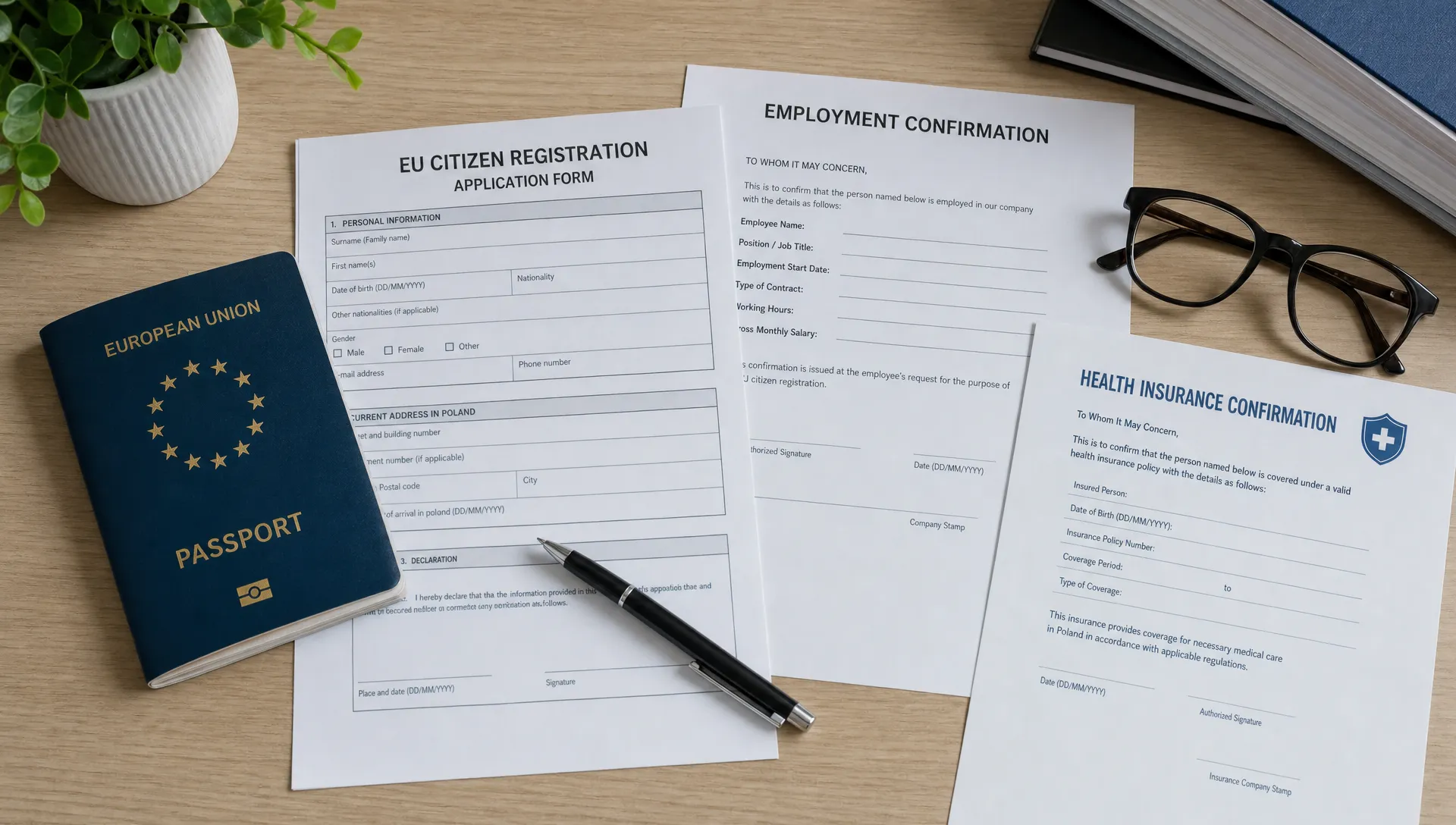
The application package normally includes identification, the completed form and evidence supporting your residence basis. Use the current official requirements rather than a checklist intended for non-EU temporary residence permits.
Typical items include:
- Application form: The form for registration of an EU citizen’s residence, completed as instructed.
- Passport or national identity card: Valid evidence of your identity and EU citizenship, with copies where required.
- Photographs: Images meeting the current official format and quantity requirements.
- Evidence of your residence basis: Employment, self-employment, study, sufficient resources or qualifying family documents.
- Health insurance evidence: Where required for your category, documents showing the relevant coverage.
- Supporting originals and translations: Originals for inspection and Polish sworn translations where required.
A student, pensioner and employee should not expect identical evidence requirements. Follow the checklist for your category and clarify anything that does not fit your circumstances before submission.
Foreign marriage or birth certificates can take longer to prepare, especially where translations or additional authentication are required. Check the rules applying to the particular document instead of assuming every foreign certificate needs the same treatment.
Attend and submit the application
Applications generally require a personal visit, with different rules for children. Check who must attend if you are registering as a family.
Bring the requested originals as well as copies. If the authority asks you to correct the form or provide further evidence, follow the deadline in its notice. Keep copies of your submission and proof of filing.
The standard procedure for EU citizen registration in Poland, including issuance of the registration certificate, is free of charge. Photographs, translations and optional professional assistance can still cost money. Do not confuse those expenses with a government application fee.
Receive the registration certificate
The document issued is called a zaświadczenie o zarejestrowaniu pobytu obywatela UE, meaning a certificate of registration of an EU citizen’s residence.
It is not the same document as a non-EU national’s temporary residence card. The distinction matters when choosing forms or explaining your status to an employer, bank or service provider.
Follow your office’s instructions for collection and any outstanding formalities. Do not build your moving schedule around an assumed processing time: appointment access and the handling of incomplete applications can affect how quickly you receive the document.
Registration, meldunek and PESEL are different tasks
One of the most common arrival mistakes is believing that receiving a PESEL number means all residence formalities are complete. These procedures serve different purposes and are handled through different administrative channels.
| Procedure | What it does | Where it is normally handled | |----------|--------------|-----------------------------| | EU residence registration | Documents your qualifying residence as an EU citizen staying beyond three months | Voivodeship office | | Meldunek | Records your permanent or temporary residential address | Municipal or commune office | | PESEL | Provides your Polish personal identification number | Often assigned through address registration, or through a separate municipal application | | Tax and social security administration | Addresses obligations arising from residence, work or business activity | Relevant tax and social security authorities |
EU citizen registration in Poland does not replace meldunek, and registering your address does not replace EU residence registration. Address registration has its own requirements and deadlines, so check those separately after settling into accommodation.
PESEL is an identifier, not proof that you meet every residence condition. Similarly, your residence certificate does not determine your tax position by itself. Tax residence depends on separate rules and facts, including your personal and economic ties and time spent in Poland.
Keeping a separate record for each procedure helps you avoid repeating an appointment or overlooking an obligation.
What to keep after registration
Save your registration certificate, filing evidence and the documents supporting your residence basis. Keep employment records, insurance evidence and any relevant family documents organized as your circumstances change.
If you move, change your personal details or lose your certificate, check the applicable notification or replacement procedure. Do not assume that updating one government record updates every other system.
EU citizen registration in Poland is also distinct from acquiring permanent residence. The general permanent-residence route usually follows five years of continuous legal residence, subject to the applicable rules and exceptions. Our guide to permanent residence for EU citizens explains that later stage without confusing it with your arrival registration.
The practical priority now is simpler: submit on time, use the correct residence basis and keep the resulting evidence accessible.
Frequently asked questions
Can I start working before receiving my registration certificate? Yes. EU citizens generally do not need a Polish work permit, and the certificate is not what creates your right to work. You must still meet the registration requirements for a longer stay.
Does every family member use the same application? No. An EU-national family member uses the relevant EU registration procedure, while a non-EU family member may need a residence card under the EU-family framework. Check each person’s citizenship and circumstances separately.
Do I need to own a property to register? No. Property ownership is not a general condition of EU residence registration. Evidence of where you live and documentation needed for address registration are separate practical questions.
What should I do if I have missed the deadline? Contact the relevant voivodeship office and arrange to submit promptly. Explain your circumstances accurately and seek qualified advice if your residence basis is unclear. Do not assume that a late application removes your underlying EU rights or that it has no consequences.
Is EU citizen registration in Poland the same as getting permanent residence? No. Initial registration documents your qualifying stay beyond three months. Permanent residence is a separate status generally acquired after five years of continuous legal residence.
Plan the paperwork around your move
If you want help organizing your arrival, Move2Poland offers discovery calls and personalized relocation planning, including visa and residency guidance. Use that support to clarify your route and sequence the practical tasks, then confirm the current filing requirements with the authority handling your application.