
Polish Citizenship by Descent: Who Qualifies?
Have a Polish parent, grandparent or great-grandparent? Learn how descent claims work, why birthplace alone is not enough and which legal breaks can affect UK families.
By Move2Poland··Updated 17 September 2026
For many people in the UK, Polish citizenship by descent starts with a family story: a Polish grandparent who settled after the war, a great-grandparent born in Lwów or Wilno, a parent who spoke Polish at home but never held a Polish passport. The first surprise is that this is usually not an application to “become” Polish. It is a request for Poland to confirm that you have been a Polish citizen all along because citizenship passed down through your family.
The short answer is this: you may qualify if one of your ancestors was a Polish citizen and Polish citizenship passed from that person to each next generation without being lost before the next person in the line was born. There is no simple grandparent limit, but there are several historical rules that can break the chain.
This article explains the qualification test, the common pitfalls for British families and what to check before you invest time and money in documents.
Polish citizenship by descent is about an unbroken legal chain
Poland follows a bloodline principle, known as jus sanguinis. In simple terms, a child of a Polish citizen can acquire Polish citizenship by birth, even if born outside Poland. For modern cases, this is often straightforward. For older family histories, especially those involving migration, war, border changes and foreign naturalization, the details matter.
A descent claim normally asks the Polish authorities to confirm possession of Polish citizenship. That is different from recognition after years of residence or a discretionary grant by the President of Poland. If your descent claim succeeds, the authority is confirming that citizenship already exists under Polish law.
The Polish Ministry of Interior and Administration outlines the main ways Polish citizenship can be acquired or confirmed. For UK movers comparing options, it also helps to understand how descent fits alongside residence-based routes, which we cover in more detail in Move2Poland’s guide to how to get Polish citizenship.
The basic qualification test
Most Polish citizenship by descent cases turn on three questions.
First, was your ancestor a Polish citizen? Birth in Poland is relevant, but it is not enough by itself. The ancestor must have acquired Polish citizenship under the law in force at the time.
Second, did that ancestor keep Polish citizenship until the next person in your direct line was born? If citizenship was lost before the child’s birth, the chain usually stops there.
Third, did citizenship legally pass through each generation? The answer can depend on the year of birth, the parents’ marital status, the father’s citizenship, the mother’s citizenship and whether any declarations or legal events affected the family.
You do not usually qualify because you feel culturally Polish, have a Polish surname or can show that a relative lived in a place that is now or once was Poland. Those facts may help with research, but the legal test is stricter.
Which ancestors can count?
A qualifying ancestor could be a parent, grandparent, great-grandparent or more distant direct ancestor. Polish law does not set a simple two-generation cutoff for confirmation cases. In theory, citizenship can pass through multiple generations. In practice, every extra generation adds more documents, more legal history and more chances for the chain to have been broken.
The strongest cases often involve a parent who is clearly Polish or a grandparent who held Polish documents and did not lose citizenship before having children. Cases involving great-grandparents can still work, but they require careful reconstruction.
Common qualifying evidence may include:
- Polish passports, military records or identity papers
- Polish birth, marriage and death records
- Foreign naturalization records, especially British records
- Records showing residence in Poland after 1920
- Documents proving each parent-child relationship in the chain
The date 1920 matters because Poland’s first modern citizenship law came into force after the restoration of Polish independence. Someone born in Polish territory before independence did not automatically create a usable descent line for every descendant. You usually need to show that the person became a Polish citizen under Polish law and did not lose that citizenship too early.
Birthplace alone is not enough
One of the most common mistakes is assuming that “born in Poland” equals “Polish citizen.” It might, but not always.
This is especially important for families from areas that changed borders during the 20th century. A relative may have been born in a town that was in the Second Polish Republic between the world wars, but is now in Ukraine, Belarus or Lithuania. That history can support a claim, yet the authority will still ask whether the person had Polish citizenship under the law of the relevant period.
The reverse can also be true. A person born outside Poland may still have been Polish if their Polish parent could pass citizenship to them. For descent purposes, the legal citizenship link matters more than the modern map.
What can break the citizenship chain?
A descent claim fails if Polish citizenship was lost before it could pass to the next generation. The risk depends heavily on dates. Polish citizenship laws changed several times, including major changes in 1920, 1951, 1962 and 2009.
Older law can be unforgiving. Before 1951, a Polish citizen could lose citizenship in situations such as acquiring a foreign nationality, entering foreign military service or accepting certain public roles in a foreign state without Polish permission. The exact effect depends on the law in force and the facts of the case.
For UK families, foreign naturalization is often the issue. If a Polish ancestor became British before their child was born, that may have broken the chain. If they became British after the child was born, the child may already have acquired Polish citizenship, although other rules may still need to be checked.
Marriage and gender rules also matter. Before 1951, citizenship transmission was not fully equal between men and women. Legitimate children generally followed the father’s citizenship under the 1920 law. A Polish mother could be central to a successful claim in some circumstances, but not in every family structure or time period. This is one reason why two cousins with the same Polish grandmother can sometimes receive different legal outcomes.
The safest approach is not to guess from family stories. Build a timeline with exact dates of birth, marriage, emigration, foreign naturalization, military service and death.
Common qualification scenarios
The table below gives a practical overview. It is not a substitute for legal analysis, but it shows how Polish authorities tend to think about descent claims.
| Family situation | Likely issue to check | Possible outcome | |---|---|---| | Your parent is a Polish citizen and was Polish when you were born | Proof of parentage and parent’s citizenship | Often a strong case | | Your grandparent was Polish and had your parent before naturalizing abroad | Whether citizenship passed to your parent at birth | Often worth investigating | | Your grandparent naturalized as British before your parent was born | Possible loss before transmission | Chain may be broken | | Your Polish ancestor left Europe before 1920 | Whether they ever acquired Polish citizenship | Often difficult, sometimes not viable | | Your claim runs through a Polish grandmother before 1951 | Marriage, legitimacy and father’s citizenship rules | Needs careful review | | Your ancestor was born in former Polish territory now outside Poland | Citizenship status under historical Polish law | Possible, but birthplace alone is not enough |
Documents you will usually need
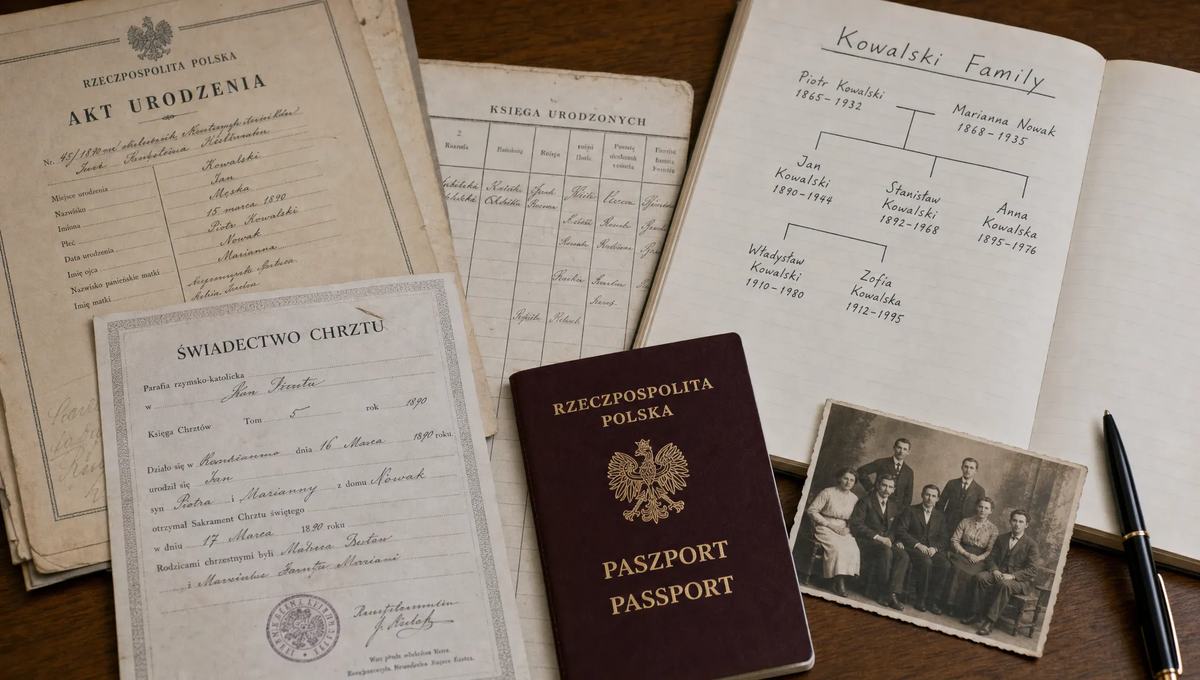
A successful case is document-driven. Polish authorities will not usually accept family memory as proof, even when the story is true. You need a clear paper trail from the Polish ancestor to you.
Expect to gather records for each person in the direct line, not just for the Polish ancestor. If your claim runs through your grandmother, then you need documents for your grandmother, your parent and yourself. If it runs through a great-grandparent, add another generation.
Key document categories usually include:
- Civil status records: birth, marriage, divorce and death certificates where relevant
- Name-change evidence: documents showing spelling changes, Anglicized names or remarriages
- Citizenship records: Polish passports, old identity cards, foreign naturalization files or certificates of non-naturalization
- Residence and military records: useful where citizenship status depends on historical residence or service
- Translations and formalities: foreign documents often need apostilles or legalization and sworn translations into Polish
British records can be particularly important. If your ancestor settled in the UK, you may need to prove whether they naturalized, when they naturalized or that they never naturalized. A missing naturalization record can be as important as a found one, but it must be obtained from the right source and presented properly.
How the confirmation process works
The usual procedure is an application for confirmation of possession or loss of Polish citizenship. If you live abroad, you may be able to start through a Polish consulate, though the decision is made by the competent Polish authority. If you are already in Poland, you can usually work through the relevant voivodeship office.
The authority reviews the legal chain generation by generation. If it confirms that you are Polish, the next practical steps may include registering foreign civil records in Poland, obtaining a PESEL number and applying for a Polish passport. These steps can feel bureaucratic, but they are separate from the core question of whether citizenship exists.
Timelines vary. A simple parent-based case may be faster than a complex great-grandparent case involving archives in several countries. Older cases can take months or longer, especially when records need to be found, corrected, translated or reconciled across different spellings.
What Polish citizenship by descent means for UK citizens
For British citizens, confirmation of Polish citizenship can change the relocation picture significantly. A confirmed Polish citizen can live and work in Poland as a Polish national rather than applying as a third-country resident. Since Poland is in the EU, Polish citizenship also gives EU citizenship rights, although practical requirements such as documents, registration and tax residence still need attention.
Dual nationality is usually not the obstacle people fear. Poland allows dual nationality, and the UK does too. The practical point is that Polish authorities generally treat a dual Polish citizen as Polish when dealing with them in Poland. Move2Poland explains this in more detail in our guide to dual nationality in Poland.
Citizenship also does not decide everything. It does not automatically make you tax resident in Poland, solve schooling decisions, choose a city for your family or tell you whether the move suits your temperament. If your goal is work, business access or an EU base, citizenship is only one part of the decision. Some people compare several jurisdictions before committing, including practical business questions such as where to find office space in Malta or how commercial setup compares with Poland’s main cities.
If you do not qualify by descent, that does not necessarily mean Poland is off the table. UK citizens can still explore post-Brexit residence options, work routes and longer-term citizenship paths after living in Poland. For the relocation side, start with the practical rules in our article on post-Brexit visas for UK citizens moving to Poland.
Red flags that deserve a closer look
Some cases look strong at first but become weaker once the dates are checked. Others look doubtful but are actually viable because the key loss event happened after the next generation was born.
Be cautious if any of the following appear in your family timeline:
- The Polish ancestor naturalized in the UK before the birth of the child in your line
- The claim runs through a married Polish woman before 1951
- The ancestor emigrated before Poland’s 1920 citizenship framework took effect
- There was foreign military service or government employment before 1951
- Names, birth dates or places differ between Polish and British records
- The family came from a borderland area with changing state control
None of these facts automatically ends the case. They simply mean you should not rely on a quick online answer.
When you probably do not qualify by descent
You probably do not qualify through descent if your Polish ancestor lost Polish citizenship before the next generation was born. You may also struggle if the ancestor left before Polish citizenship could have been acquired or if the only evidence is a surname, religion, ethnicity or family tradition without documents.
There are also cases where a person has Polish heritage but no legal citizenship chain. This can be disappointing, especially for families with strong cultural ties to Poland. The law is concerned with citizenship transmission, not identity alone.
Other routes may still exist. Recognition as a Polish citizen after residence, a presidential grant, restoration for certain former citizens or normal residence planning may be more relevant. Each route has different rules, timelines and levels of discretion.
A practical first step: build the timeline before applying
Before paying for archives or submitting anything, create a simple family timeline. Start with yourself and work backward to the Polish ancestor. For every person, note exact dates and places of birth, marriage, emigration, foreign naturalization and death.
Then ask one question at each generational step: was the parent still Polish on the day the child was born, and could that parent pass citizenship under the law then in force?
If the answer is clearly yes at every step, you may have a strong descent case. If one answer is unclear, focus your research there. If one answer is clearly no, you may need to consider another route.
Frequently Asked Questions
Can I get Polish citizenship if my grandparent was Polish? Possibly. A Polish grandparent can qualify you only if citizenship passed from your grandparent to your parent, then from your parent to you, without being lost before each birth.
Is there a generation limit for Polish citizenship by descent? There is no simple grandparent-only limit in confirmation cases. The challenge is proving an unbroken citizenship chain through every generation.
Does a Polish surname help? A surname may help with family research, but it does not prove Polish citizenship. You need records showing citizenship status and parent-child links.
What if my ancestor was born in a town that is no longer in Poland? That can still be relevant if the town was under Polish jurisdiction at the right time and your ancestor acquired Polish citizenship. Modern borders do not decide the issue by themselves.
Can I keep my British citizenship if I confirm Polish citizenship? In most cases, yes. Both Poland and the UK allow dual nationality, although Poland will treat you as Polish when you deal with Polish authorities in Poland.
Do I need to speak Polish to claim citizenship by descent? Language is not usually the central requirement for confirmation of existing citizenship. Documents and legal continuity matter more. Polish language ability may be relevant for other citizenship routes.
How long does confirmation take? It depends on the complexity of the case, the authority handling it and whether documents are complete. Older multi-generation cases often take longer because archives and legal analysis are more involved.
Considering Poland through ancestry? Make the wider decision carefully
Polish citizenship by descent can be a powerful route, but it should sit inside a bigger life decision. Before you move, think about residence practicalities, taxes, healthcare, schools, work structure, city choice and whether daily life in Poland fits your expectations.
Move2Poland helps individuals and families make that decision with honest relocation guidance, discovery calls, a Poland decision guide and practical planning support. If ancestry is part of your Poland story, start by clarifying the citizenship chain, then build a realistic plan for the move itself.